
Practical calculator guide
Bond Calculator Guide: Inputs, Formula and Result Interpretation
Bond Calculator explained with formula context, a practical U.S. example, step-by-step instructions, interpretation guidance, common mistakes, FAQs, and links to related tools.
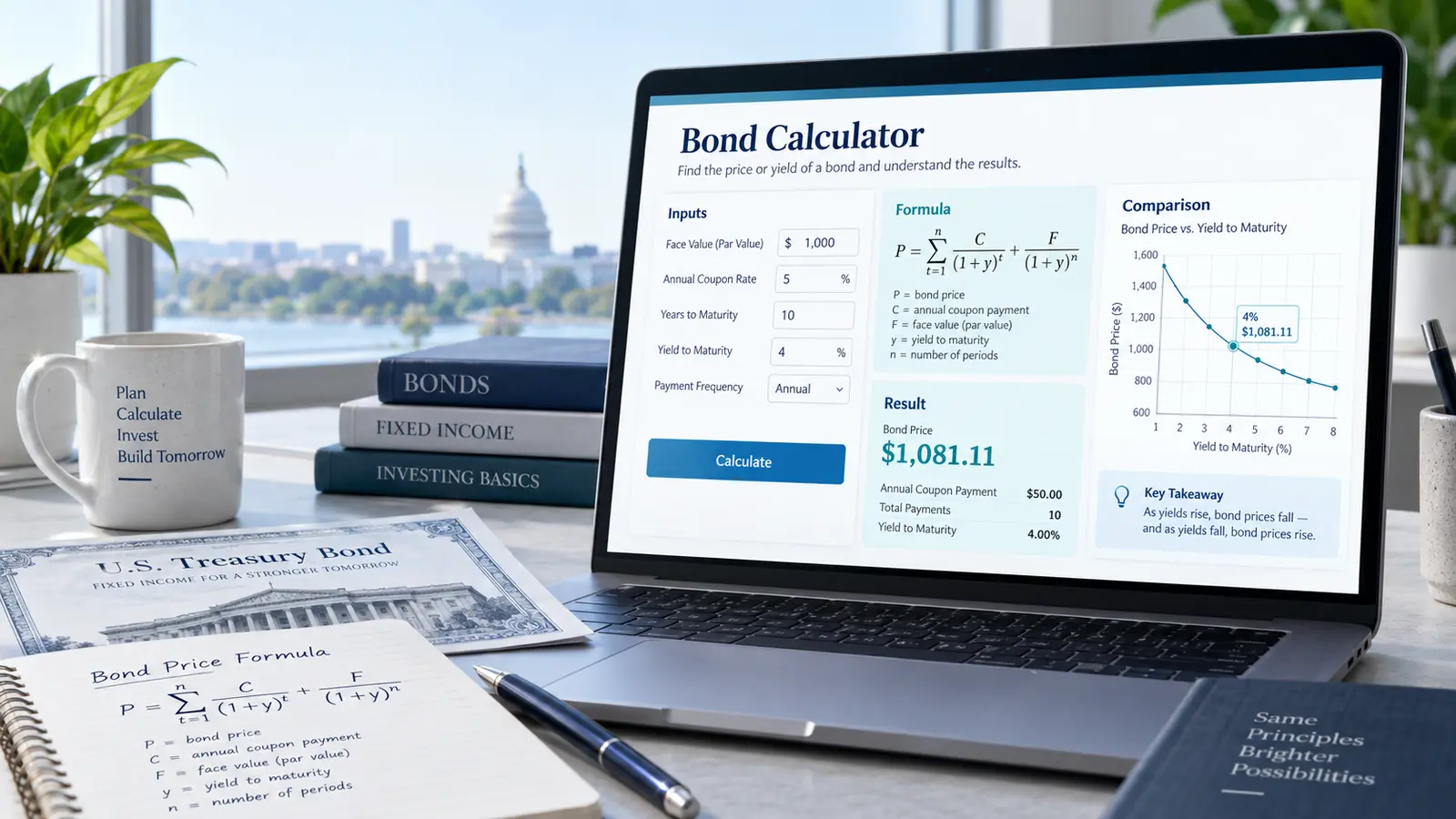
Bond Calculator Guide: Inputs, Formula and Result Interpretation
Bond Calculator helps users estimate or calculate bond from the values they enter. Start with current, correctly labeled inputs; keep units and time periods consistent; review the formula and assumptions; and compare at least two realistic scenarios before using the result for planning. Open the Bond Calculator to calculate your result while following this guide.
For a broader comparison, review the Debt Payoff Calculator and Home Equity Loan Calculator. You can also browse all Finance calculators to select the tool that most closely matches your question.
What does the Bond Calculator calculate?
A bond calculator estimates a bond's price, yield to maturity, and total return by factoring in face value, coupon rate, maturity date, and current market interest rates. The most useful result is not simply the displayed number. It is an estimate tied to the exact inputs, units, dates, rates, assumptions, and options selected. Record those details whenever you compare results or revisit the calculation later.
Before entering data, define the question you want the calculator to answer. Decide whether you need a current estimate, a future projection, a comparison between alternatives, or a unit conversion. This prevents a precise-looking result from answering the wrong question. Gather source values from current statements, measurements, official records, product labels, or provider terms instead of relying on memory.
Bond formula
Result = entered financial values combined according to the rate, time period, cash-flow timing, and calculation method selected in the tool.
Formula symbols and inputs must refer to the same period and unit system. Convert percentages to decimal form when required, distinguish annual rates from periodic rates, and avoid rounding intermediate values. If the calculator offers different methods, each method may use a different assumption set; select the method that matches the real situation and note why it was chosen.
Variables and inputs explained
- Primary value: the main amount, measurement, balance, price, distance, or personal input used to begin the calculation.
- Rate or factor: the percentage, conversion factor, activity multiplier, coverage rate, or published equation applied to the primary value.
- Time or quantity: the number of years, months, payments, units, repetitions, servings, or measured sections included.
- Optional adjustments: fees, taxes, contributions, waste, insurance, goals, or other inputs that refine the estimate.
- Output unit: the currency, percentage, time period, measurement unit, or category in which the answer is displayed.
Read every field label before typing. A value that is correct by itself may be wrong for the requested field—for example, an annual amount entered into a monthly field or inches entered where feet are expected. Use zero only when the factor genuinely does not apply. Do not use a blank field to mean “unknown” unless the page explicitly describes that behavior.
Verified-style U.S. example
Consider a U.S. household comparing a realistic bond scenario before making a commitment. The user enters current dollar amounts, the applicable annual rate, the correct time period, and known recurring costs. A second scenario changes only one important assumption so the payment, interest, balance, or return difference remains understandable.
The base case should first be checked for direction and scale. If the primary amount increases, determine whether the result should increase, decrease, or remain unchanged. Then modify one variable at a time. This sensitivity check shows which assumption drives the result and helps identify accidental unit, sign, decimal, or percentage errors before the number is used.
Step-by-step calculation process
- Define the result you need and the date or period it should represent.
- Collect current values from reliable records or measurements.
- Choose one unit system and convert mismatched inputs before calculating.
- Enter the required values and review decimal placement, signs, and rate periods.
- Select the calculation option that matches your situation.
- Compare the output with a rough independent estimate.
- Change one key input and calculate a second scenario.
- Save the result together with its assumptions and verification date.
How to interpret the result
Treat the bond result as a planning scenario rather than an offer, tax determination, investment promise, or lending decision. Provider rules, credit profile, fees, taxes, insurance, market returns, and timing can change the real outcome.
Focus on decision-relevant differences rather than false precision. Small differences can be caused by rounding, compounding conventions, calendar treatment, measurement technique, or the inclusion of optional costs. Large unexpected differences usually deserve an input review. When the decision affects money, health, safety, eligibility, or a legal obligation, verify the applicable rule with an authoritative source or qualified professional.
Base case versus comparison case
| Review point | Base case | Comparison case |
|---|---|---|
| Inputs | Most realistic current values | Only one major input changed |
| Purpose | Establish the expected result | Measure sensitivity and trade-offs |
| Precision | Keep full calculation precision | Use the same rounding convention |
| Decision use | Planning benchmark | Alternative, risk, or range check |
Common mistakes to avoid
- Mixing monthly and annual figures without conversion.
- Using the wrong measurement system or output unit.
- Entering a percentage as a whole number when a decimal is required, or vice versa.
- Leaving out material fees, costs, adjustments, or limitations.
- Rounding each intermediate step instead of only the final result.
- Assuming an estimate is an approval, diagnosis, official determination, or guarantee.
- Comparing scenarios that use different definitions or time periods.
- Copying an old result after rates, measurements, rules, or personal inputs have changed.
How to improve result quality
Use the newest available inputs and document their source. Repeat physical measurements, confirm rate dates, and review whether optional fields are included in the result. For calculations with future assumptions, create conservative, expected, and optimistic cases rather than relying on one forecast. For conversions, state the exact source and target unit. For health estimates, use consistent measurement conditions and follow the population limits of the equation.
A calculator is most valuable when it makes assumptions visible. Keep a brief note containing the calculation date, the values entered, the selected method, the displayed output, and any external verification performed. This makes the comparison reproducible and reduces the chance that a rounded number will be reused without its original context.
Frequently asked questions
Is the Bond Calculator exact?
The tool applies its stated method to the entered values, but the practical accuracy of the result depends on input quality, applicable assumptions, rounding, and whether the formula represents the real situation.
Which inputs matter most?
The primary amount or measurement, the rate or conversion factor, the time period, and any major optional adjustment usually have the greatest effect. Test them individually to understand sensitivity.
Why does another calculator show a different answer?
Different tools may use different defaults, formulas, compounding rules, calendar conventions, data sources, unit definitions, or rounding. Compare the assumptions before comparing the final numbers.
Can I use the result for an official decision?
Use it as an educational planning estimate. Confirm high-impact financial, medical, tax, legal, construction, academic, or eligibility decisions with the authority, provider, product documentation, or qualified professional responsible for the applicable rule.
Calculate your result
Use the Bond Calculator with current inputs, calculate a base case, and change one important value to compare outcomes. Keep the result together with the assumptions that produced it.
Weight Gain Explained: Formula, Worked Example and Common Mistakes
How to Calculate Calorie Surplus: Step-by-Step Guide with Example
Loan Calculator: Simplify Your Loan Payment Estimates
Repayment Before and After Calculator
Paint Calculator: Estimate Your Paint Needs Quickly and Accurately
House Affordability Calculator: Find Your Budget Easily
Pregnancy Due Date Calculator in the USA
Cups to Ounces Conversion Calculator
Boat Loan Calculator: Estimate Your Monthly Payments
Mortgage Payoff Calculator: Estimate Your Remaining Balance and Payoff Date
Calculate Your Daily Fiber Intake in Pounds
Student Loan Calculator for Early Payoff Planning
Body Fat Calculator: Estimate Your Body Composition
Meters to Feet Conversion: How Many Feet Is 30 Meters?
Investment Calculator: How Much Will Your Investment Grow?
Pregnancy Due Date Calculator by Last Period
Personal Loan Loan Term Calculator
Understanding How an Interest Rate Calculator Works
Present Value Calculator for Monthly Contributions
Kilometers To Miles Conversion Calculator
Pregnancy Due Date Calculator: How to Estimate Your Baby’s Arrival
Square Footage Calculator for Land
Calculate Sugar Intake with Activity Level
FHA Loan Calculator for Early Payoff
How to Calculate Discount for Beginners
Protein Calculator for Men: Find Your Daily Protein Needs
Feet and Inches to Centimeters Conversion Calculator
Paint Calculator: Estimate Your Paint Needs Without Signup
Pregnancy Calculator: How to Calculate Your Pregnancy Cycle Length
Gallons to Liters Conversion Calculator
Fahrenheit to Celsius Converter
Debt To Income Ratio Calculator
Convert 20 cm to Inches: Easy & Accurate Measurement
Debt Payoff Calculator: Estimate Your Debt-Free Date
Bond Calculator: Determine Your Bond’s Before and After Values
Sleep Cycle Calculator: Find Your Ideal Sleep Schedule
Meters to Feet Conversion Calculator
Sleep Calculator: Find Your Best Wake Up Time
Sugar Intake Calculator: How Much Sugar Are You Consuming?
Cups to Ounces Conversion Calculator
FHA Loan Calculator: Estimate Your Monthly Payments
Interest Rate with Inflation Calculator
FHA Loan Calculator: What Information Do You Need?
Pregnancy Weight Gain Calculator
BMI Calculator: Find Your Body Mass Index Quickly and Accurately
Heart Rate Calculator for Resting Rate
Understanding How a Depreciation Calculator Works
Calculate Your Ideal Weight in the US with Our Free Tool
Calculate Your BMR for a Very Active Lifestyle
Walking Calorie Calculator: Estimate Calories Burned While Walking
TDEE Calculator: Find Your Daily Calorie Needs by Age & Activity
Investment Calculator: Estimate Your Future Savings Without Signup
Lease Calculator: Estimate Your Monthly Payments
Square Footage Calculator for Flooring
Sleep Cycle Calculator: Optimize Your Sleep Schedule
Fahrenheit to Celsius Conversion Calculator
Heart Rate Calculator: How to Calculate Your Heart Rate
Kilometers to Miles Conversion Calculator
Annuity Payout Calculator for Monthly Payments
Savings Calculator: Easily Estimate Your Savings Growth
Profit Margin Calculator: Convert Markup to Margin Easily
Cd Calculator: Determine Your Object’s Drag Coefficient
Rental Property Calculator with Mortgage Included
One Rep Max Calculator for Women
How to Calculate Your Daily Fat Intake in Grams
VAT Calculator for Vehicle Purchases in the US
FHA Loan Calculator & Amortization Schedule
Feet To Cm Converter: Convert 12 Feet to Centimeters
Water Intake by Weight Calculator
Rental Property Cap Rate Calculator
Future Value Calculator Starting Principal
Auto Loan Calculator: Estimate Your Car Payments
Annuity Payout Calculator: Calculate Future Value of Your Payments
Pace Calculator: Find Your Running Speed in Minutes per Mile or Kilometer
Rental Property Cash on Cash Return Calculator
Fahrenheit to Celsius Conversion Calculator
Sodium Intake Calculator: How Much Salt Are You Consuming?
Mortgage Calculator: Easily Estimate Your U.S. Home Loan Payments
Auto Loan Calculator for Early Payoff
Paint Calculator for Accurate Paint Estimation in the USA
ROI Calculator for 2026: Estimate Your Investment Returns
Kidney Function eGFR Calculator: Estimate Your Kidney Health
Liters to Gallons Conversion Calculator
VO2 Max Calculator: Estimate Your Aerobic Capacity and Max Heart Rate
Rent Calculator: Estimate Your Monthly Rent Payments
Gallons to Liters Converter: Convert 100 Gallons to Liters Easily
Paint Calculator: Calculate Your Paint Needs Online
Cash Back or Low Interest Calculator for Investment Growth
IRA Calculator: Estimate Your Retirement Savings
Concrete Calculator for Cubic Yards
Calculate Your Average Investment Return Easily
IRA Calculator: Estimate Your Retirement Savings Potential
64 CM to Feet Conversion Calculator
Pregnancy Weight Gain Calculator by Goal Date
Roofing Calculator: Estimate Your Roofing Costs Online
Pregnancy Weight Gain Calculator: Estimate Your Maintenance Calories
Net Margin Calculator: Determine Your Profit Margin Easily
Pregnancy Due Date Calculator by Last Period